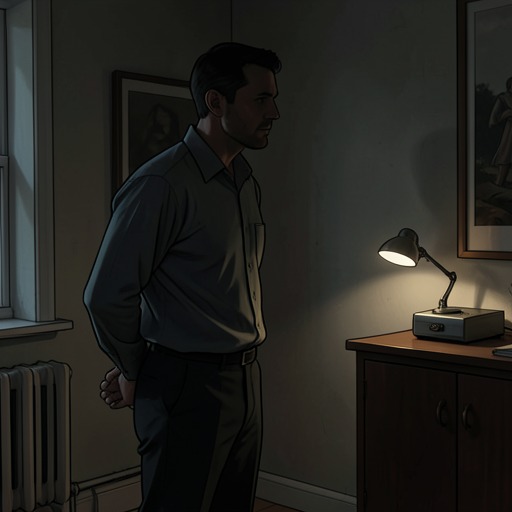
Hanna leaves Heidelberg
The ReaderHanna leaves Heidelberg abruptly, ending her relationship with Michael without explanation and turning his failure to answer her earlier unspoken appeal into an enduring source of guilt. He discovers her absence through ordinary traces—a silent apartment, a missed shift, a change-of-address record—while the decisive encounter remains fixed in his memory as the moment when he recognized her too late.
The Discovery of Her Absence
The day after Michael last saw Hanna, he arrives at the apartment at their usual time and rings the bell. From the door, everything appears unchanged; he can hear the clock ticking. He sits on the stairs, where he had sat before, and realizes that he had gradually stopped asking which streetcar line she was working or wondering about her routine. The familiar setting makes her absence seem at first like a delay, but the unchanged room offers no sign of what has happened.
Michael calls the streetcar company from a telephone booth at Wilhelmsplatz. After being transferred from one person to another, he learns that Hanna has not come to work. He then goes back to Bahnhofstrasse, asks at the carpenter’s shop in the yard for the building owner’s name and address, and rides to Kirchheim. A woman answers through a window in the door and tells him that Frau Schmitz moved out that morning. When he asks about the furniture, she replies that it was not Hanna’s. The details confirm that the apartment had not been a settled home furnished with possessions of her own, but they provide no destination or explanation.
The Departure Confirmed
At the streetcar company’s administration building, Michael manages to reach the personnel department. The man in charge says Hanna called early enough for the company to arrange a substitute and stated that she would not be coming back. He remembers that two weeks earlier he had offered to train her as a driver, but she has now abandoned that possibility as well as her existing job. Her departure is therefore not merely an unexplained absence from Michael’s life: she has severed her connection to work and rejected an immediate path to advancement.
Only after several days does Michael think to check the citizens’ registration office. He learns that Hanna reported she was moving to Hamburg but supplied no address. The notice gives him a city, not a way to find her. Each institution yields one fragment—she has quit, left the apartment, and registered a move—yet none provides the contact that could turn information into reunion. The sequence makes the disappearance concrete while keeping its purpose and future beyond Michael’s reach.
Michael’s Guilt and the Last Encounter
In the days after Hanna leaves, Michael feels sick but conceals his distress from his parents and siblings. He joins the family conversation a little, eats a little, goes to school and to the swimming pool, and finds an out-of-the-way place where no one will look for him. His body yearns for Hanna, but he identifies his guilt as worse than physical desire. He reproaches himself for not running to her when she stood before him, and reads her departure as punishment for his halfheartedness, his denial of her, and his betrayal.
He tries to loosen the force of that conclusion by questioning his own recognition: because he could not make out her face, perhaps it had not been Hanna. But this uncertainty cannot hold. He knows it was her; she had stood and looked at him, and by the time he accepted what the encounter demanded, it was too late. The departure thus gathers meaning from the missed moment preceding it. Hanna’s silence leaves Michael without her reasons, while his own retrospective narration supplies a painful interpretation: her leaving becomes the consequence he attaches to his failure to respond.
Narrative Significance
The episode is narrated through Michael’s later recollection, which places the practical search beside an inward account of blame. Its sequence moves from the apartment and the ticking clock to workplaces and official records, then from those external confirmations to the remembered image of Hanna looking at him. The contrast is central: the institutions can establish where she no longer is and where she said she was going, but they cannot explain the personal rupture.
Her departure also changes the meaning of earlier habits. Michael remembers that he once knew which line she worked, although he had stopped asking; what had become routine now appears to him as a form of withdrawal. The missed opportunity to train as a driver and the unaddressed move to Hamburg sharpen the finality of her decision without disclosing its motive. Hanna leaves Heidelberg beyond his reach, and Michael is left with an absence he can document but not resolve, and a last look that he continues to interpret as an accusation.